California · GJEL archive
The Dangers of Texting and Driving
By Andy GillinFounding and managing partner, GJEL Accident Attorneys
 It is no secret that texting and driving is dangerous. In fact, it is one of the most dangerous things a person can do while behind the wheel. Every year, thousands of people are killed or injured in car accidents caused by texting and driving.
There are a number of reasons why texting and driving is so dangerous. First, it takes a driver's attention away from the road. When a driver is focused on sending or reading a text message, he or she is not paying attention to the task of driving. This can lead to serious accidents.
Second, texting and driving can cause a driver to lose control of his or her vehicle. A car that is being driven while the driver is texting is more likely to cause an auto accident.
It seems hardly a day goes by without hearing something in the news about an accident caused by texting and driving, in California and throughout the US. The fact is that texting while operating a vehicle is a form of “distracted” driving, which is a term used to describe any activity that diverts attention away from what should be the primary task at hand: Driving. Let's look at the dangers of texting and driving in the US.
It is no secret that texting and driving is dangerous. In fact, it is one of the most dangerous things a person can do while behind the wheel. Every year, thousands of people are killed or injured in car accidents caused by texting and driving.
There are a number of reasons why texting and driving is so dangerous. First, it takes a driver's attention away from the road. When a driver is focused on sending or reading a text message, he or she is not paying attention to the task of driving. This can lead to serious accidents.
Second, texting and driving can cause a driver to lose control of his or her vehicle. A car that is being driven while the driver is texting is more likely to cause an auto accident.
It seems hardly a day goes by without hearing something in the news about an accident caused by texting and driving, in California and throughout the US. The fact is that texting while operating a vehicle is a form of “distracted” driving, which is a term used to describe any activity that diverts attention away from what should be the primary task at hand: Driving. Let's look at the dangers of texting and driving in the US.
Examples of Distracted Driving
- Not paying attention when Autopilot is enabled
- Surfing the internet or talking on the phone;
- Taking a photo;
- Checking weather or maps;
- Viewing social media;
- Eating or drinking;
- Grooming;
- Utilizing audio controls or navigation system; and,
- Many others.
Why Is Texting and Driving Bad?
Texting and driving is a bad practice because it involves cognitive, visual, and manual distractions, all of which can impair a driver's ability to react quickly to changing driving conditions. This dangerous behavior can cause delayed reaction times, poor decision-making, swerving, drifting, and other dangerous driving behaviors, leading to serious accidents that can result in injury or death.
Despite laws and awareness campaigns aimed at preventing texting and driving, it continues to be a leading cause of distracted driving accidents in the US, and it is important for drivers to understand the risks and take steps to prevent accidents on the road.
The Three Types of Distracted Driving According to the CDC
- “Visual: taking your eyes off the road;
- Manual: taking your hands off the wheel; and
- Cognitive: taking your mind off of driving.” Texting and driving uses all three types of distraction. Your eyes are on the phone, so they can’t be on the road. Your hands are on the phone, so they can’t be on the wheel. Your mind is on the message you’re reading or replying to.
Understanding Why Texting and Driving is so Dangerous
A driver is forced to perform a number of primary, necessary tasks to safely operate motor vehicles; secondary, unnecessary activities interfere considerably with the fundamental tasks. Texting presents a major distraction to the operator’s ability to perform the critical tasks required to drive safely.Texting as an Internal Distraction
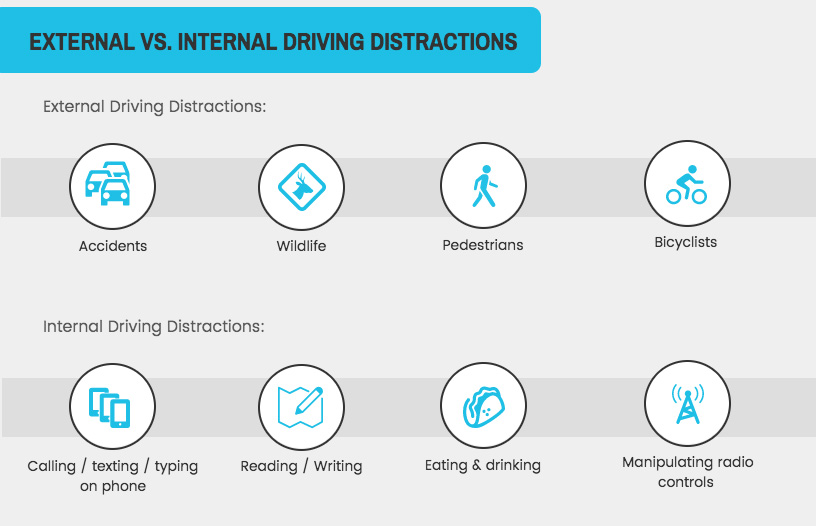 Distractions outside the car, such as an accident, animal, pedestrian, bicyclist, emergency vehicle, are external in nature. Texting while driving is internal because it takes place within the confines of the vehicle. Distractions can be further broken down into three main categories:
-
Visual Distractions
When the motorist’s visual focus drifts to something other than the road and surrounding conditions, it’s a visual distraction. -
Manual Distractions
If an activity requires the operator to manipulate an object or device other than the steering wheel or vehicle controls, it falls into the manual category. -
Cognitive Distractions
A driver may be thinking about a topic not related to operating the car, impacting concentration and dedication to the primary task of driving.
A Summary of Texting and Driving Laws in California
The law in California bans different activities related to phone use and applies to different age groups.State Law Applicable to All Drivers
State law recently underwent an overhaul in the area of using wireless electronics while operating a motor vehicle, having been enacted in September 2016 with an effective date of January 1, 2017. Section 23123.5 of the Vehicle Code now provides:- A driver cannot hold and operate a smartphone unless the device allows and is configured for voice-operated, hands-free functioning – and it is actually being used as such while driving.
- In addition to the above, the driver can only operate the smartphone under certain conditions:
- The device is mounted to the vehicle’s windshield, in similar fashion to a GPS unit, or is affixed to the dashboard or center console; and,
- The driver is only required to single-swipe or click the smartphone to activate or deactivate its functions.
Laws Applicable to Younger Drivers
A different section of the Vehicle Code relates to drivers under the age of 18 years old: Section 23124. Drivers 17 and younger are prohibited from using any wireless telephone or electronic wireless communications device, regardless of whether it can be operated in hands-free mode.Enforcement of Texting While Driving Laws
There are two methods by which a driver may be cited for texting and driving:- Primary Enforcement: Police do have authority to pull over a driver if they witness a violation of Section 23123.5, no matter what the age. An officer doesn’t need to see any other violation in order to apprehend a motorist.
- Secondary Enforcement: Law enforcement cannot pull over a driver solely on suspicion of violating Section 23124. Police can, however, issue an additional citation for violating this section if the driver is detained for a different violation – including Section 23123.5.
Texting and Driving Statistics in the US and California
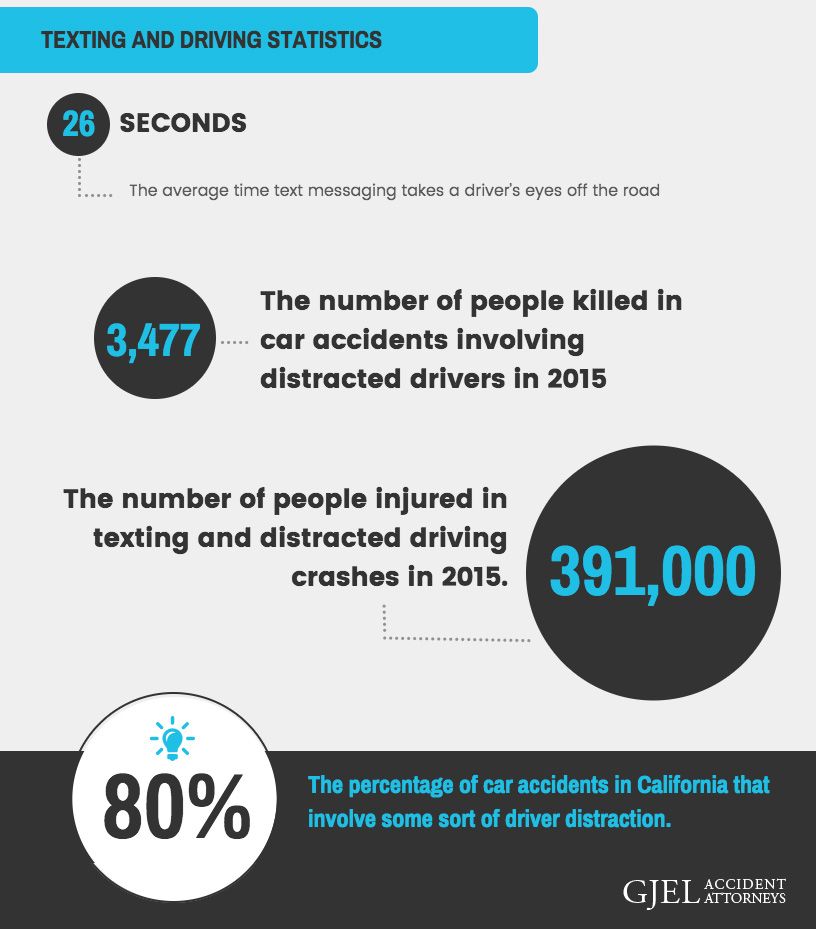 Nationwide statistics bear out how risky texting while can be, as well as how dangerous it actually is in accidents:
- Engaging in texting increases the risk of a collision by double as compared to what the NHTSA refers to as “model” driving.
- On average, text messaging takes a driver’s eyes off the road for a total of 23 seconds.
- In 2015, 3,477 people died in car accidents involving distracted drivers, including those texting at the time. That number is up from 3,154 in the year 2013 and 3,179 in 2014.
- During 2015, 391,000 were injured in texting and distracted driving crashes.
- There are around 660,000 drivers using their phones during daylight hours, despite the fact that 46 states have enacted laws prohibiting texting while driving.
- The Centers for Disease Control and Prevention reports that 31% of drivers aged 18-64 had read or sent text messages while driving at least once during the previous month. Three-quarters of drivers admit that they’ve seen others do so as well.
- 80% of car accidents in the state involve some sort of driver distraction.
- Using a phone, either by talking or texting, is the number one source of driver distractions.
- In 2014, 61% of California motorists reported in a survey they had been hit or nearly hit by a driver who was using an electronic device at the time.
- More than half of drivers in California admitted to making a driving mistake or violating a traffic law while using a cell phone.
Teens and Texting While Driving
Getting a driver’s license is among the most anticipated milestones in a teenager’s life, and many parents even look forward to the moment when their children can help with errands. However, the riskiest time period for a teen driver is within the first few months after obtaining their license. The biggest factors for teen drivers include lack of experience, risk taking, and impaired driving. However, driving while distracted by texting is at the top of the list. The age-specific statistics, both nationwide and in California, show the alarming incidence of teens who text while driving.- Of all drivers under the age of 20 that were involved in fatal crashes, 10% admitted to being distracted by text or phone use.
- Car accidents are the leading cause of death for teenagers in the US. [Find out the average wrongful death settlement here]
- On average, 7 teens die in car crashes every day.
- A transportation research study found that up to 25% of teen drivers respond to texts one or more times, every time they drive. Twenty percent of teens and ten percent of parents admit that they have extended text message exchanges while driving.
- The FCC found that 11% of motorists in the 18-20 age group who were involved in a car accident admitted that they were texting at the time of the collision.
Resources for Parents of Teen Drivers
While the numbers on teens texting and driving are staggering, there are ways parents can improve safety behind the wheel. Parents are their children’s role models, so start them off on the right foot by demonstrating compliance with all traffic laws. Wear your seatbelt, stick to the speed limit, and – most importantly – don’t engage in texting while driving. Be the motorist you want your young driver to be by eliminating distractions. It’s also smart to consider a Parent-Teen Driving Agreement, as recommended by the American Academy of Pediatrics, that lays out your expectations for your child’s use of the car. A written contract allows you to outline rules and penalties before an accident occurs – and before emotions can cause accusations to fly. Additional resources for parents include:- AAA’s Keys 2 Drive, which includes a newsletter with topics relevant to the parents of teen drivers;
- The CDC’s site, Parents are the Key to Safe Teen Driving; and,
- Automobile Club of Southern California, including its handbook “Parent & Teen Driver Resource Guide” that contains helpful tips at the Pre-Permit, Permit, and License stages.
California Initiatives & Organizations to Prevent Texting and Driving
One of the most active organizations fighting against teen texting and driving is Impact Teen Drivers, a California non-profit entity committed to educating your drivers about the risks and implications of distracted driving. The organization has an active social media presence and has reached over two million fans since its inception in 2007. Other organizations dedicated to texting and driving initiatives include:- NHTSA;
- The California chapter of AAA; and,
- The California Department of Motor Vehicles.
Why You Should Not Text While Driving
At the end of the day you shouldn't text and drive due to safety. According to a recent study, a person is 23 times more likely to get in a car accident if they are texting while driving.How Do Police Know If you're Texting?
Police know if you're texting and driving a variety of ways. The first and most obvious is if they see you texting while driving. Other times the way you're driving such as drifting lanes or getting in an accident may cause them to seek phone record evidence that could prove you were texting and driving at the time.Conclusion
Stronger enforcement by police, an increase in public awareness, and emphasis on personal accountability will have a positive impact on texting and driving. However, these initiatives do little after the fact when a victim suffers injuries in an accident that results from another motorist’s distracted driving. Injuries and death still occur at an alarming frequency, despite efforts at the national, State of California, and local levels. Apologies and regret don’t cover the astronomical medical costs of treatment or lost wages for a victim. Remorse won’t bring back a loved one who was killed due to the negligent texting of another driver. If you’ve suffered losses, it’s not a sufficient remedy to see the responsible driver get a ticket. As a victim, you may be entitled to financial compensation for the damages you sustain. However, the key to your success in recovering a monetary reward is hiring a car accident attorney with experience in California texting and driving cases. You need a lawyer that will fight for your rights against aggressive insurance companies and will protect your interests in court. For more information on texting and driving accidents in California, please contact GJEL Accident Attorneys. We’re happy to schedule a consultation at our Orinda office or at any one of our many regional locations. This post was written by Andy Gillin and updated on 3/21/23.
About the author
Andy Gillin
Andy Gillin is a founding and managing partner of GJEL Accident Attorneys. His work focuses on representing injured people in California. He has written and lectured on personal injury law, settlement strategies, and trial practice.
View profile and articles →